Can You Go Back to Normal Teeth After Porcelain Veneers?
TL;DR: Reversing Porcelain Veneers
Traditional porcelain veneers permanently reduce 0.3 to 0.5mm of enamel from the tooth surface and cannot be reversed. About 95% of standard veneer cases involve some prep. No-prep or minimal-prep veneers (Lumineers) can sometimes be removed without leaving the tooth visibly altered, but those represent only 5 to 10% of veneer cases.
Standard veneers: Permanent enamel removal, not reversible
No-prep veneers: Sometimes reversible, fewer candidates
What happens at year 15-20: Replacement, not removal
Alternative if you want reversibility: Composite bonding
Best decision: Get the right diagnosis up front
The reversibility question every veneer patient should ask before saying yes
Patients across Smyrna, Marietta, and Sandy Springs sometimes come to our office considering veneers and ask the right question: if I change my mind, can I go back? The honest answer depends entirely on what type of veneer was placed. Traditional porcelain veneers require permanent enamel reduction and are not truly reversible. No-prep options are sometimes reversible but apply to a small subset of cases. Below we walk through what happens to the tooth underneath, what reversibility actually means at year 5, 10, and 20, and the alternatives if reversibility matters to you.

What standard veneer prep actually does to the tooth
Traditional porcelain veneers require the dentist to reduce 0.3 to 0.5mm of enamel from the front of the tooth so the veneer can sit flush with the natural tooth line. Once that enamel is removed, it does not grow back. The natural tooth underneath still functions normally and stays healthy under the veneer in roughly 95% of well-maintained cases, but the visible front surface no longer has the original enamel layer. According to the American Academy of Cosmetic Dentistry, this enamel reduction is the trade-off that makes standard veneers more durable and aesthetic than alternatives. We explain this clearly at every Smyrna consultation so patients make an informed decision.
No-prep veneers: when reversibility is genuinely possible
No-prep or minimal-prep veneers (the most common brand being Lumineers) are thin enough to bond directly to the tooth surface without enamel reduction. About 5 to 10% of veneer candidates qualify for this approach, typically patients with naturally smaller teeth or specific shape issues that don't require the standard contour reduction. When patients walk in asking about reversibility, the most useful question we ask is whether they are a candidate for no-prep, and we evaluate that with a 3D scan and digital smile design preview. Our cosmetic lead, Dr. Natasha Kanchwala, walks every candidate through both options before any prep happens.
What happens when veneers come off at year 15 to 20
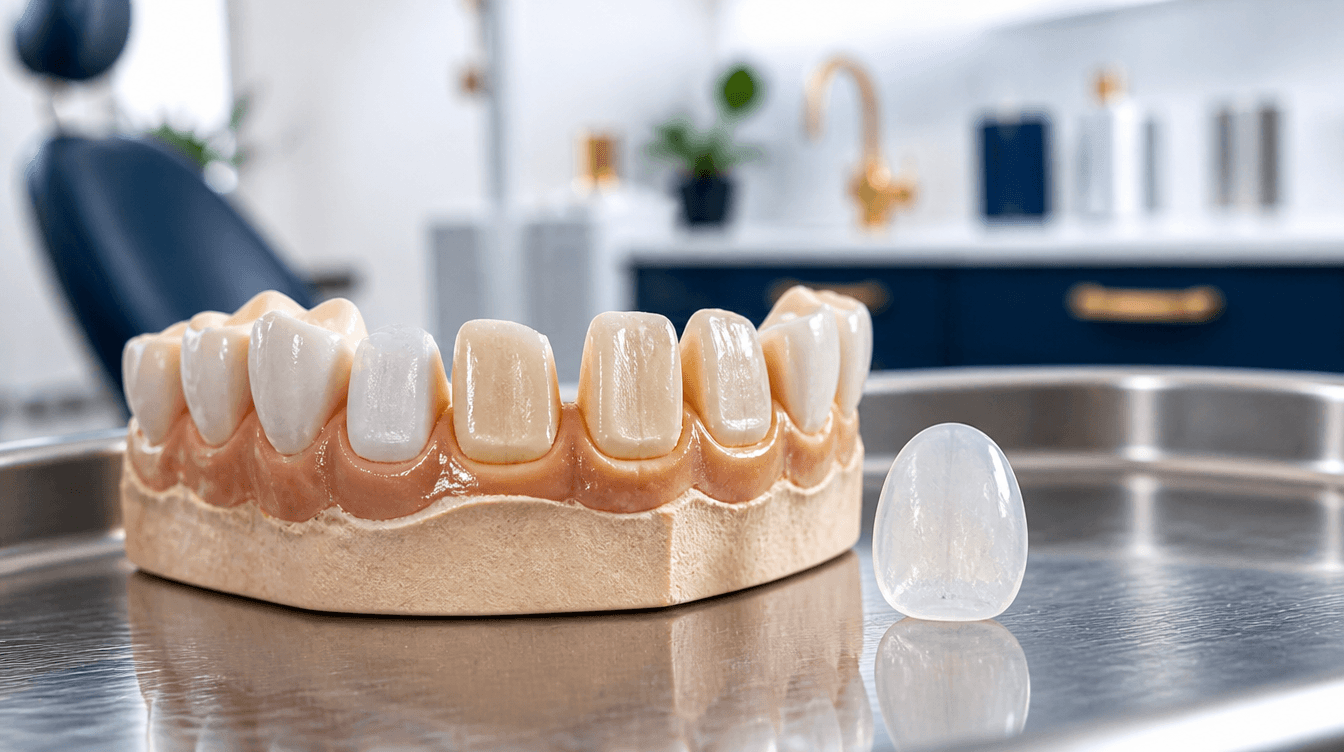
The most common scenario for veneer removal is replacement at year 15 to 20, not a return to natural teeth. When we remove an old veneer, the prepared tooth surface is still present, and the patient has three options: replace with a new veneer, place a full crown if the tooth has structural issues, or in rare cases bond a composite restoration. According to a clinical longevity review on PubMed, well-maintained porcelain veneers retain over 80% of original surface integrity at the 20 year mark, so most patients replace rather than remove. The patients we see hitting that mark with healthy underlying tooth structure all share the same maintenance habits: twice-yearly hygiene, a night guard if they grind, and early intervention when something feels off.
If reversibility matters: composite bonding as an alternative
For patients who genuinely want a reversible cosmetic improvement, composite bonding is the right alternative. A skilled cosmetic dentist can bond tooth-colored composite resin to the front of the tooth without removing enamel, achieving 70 to 80% of the visual improvement of a veneer at about 30% of the cost. Bonding lasts 5 to 8 years on average and can be polished off without permanently altering the tooth. About 20 to 25% of the cosmetic patients we see in Smyrna choose bonding as a reversible first step before committing to veneers. Our cosmetic dentistry page covers both options in detail.



Frequently Asked Questions
Will my teeth be sensitive after veneers are removed?
Mildly. The prepared tooth surface is sensitive to hot and cold for a few weeks after veneer removal. We always cement a temporary restoration immediately to protect the tooth, and a new permanent veneer or crown is placed within 2 to 4 weeks.
Can I just go back to my natural teeth without replacing the veneers?
If you had standard veneers, no, the prepared tooth surface needs a restoration to protect it from sensitivity, decay, and wear. A composite restoration can be placed in some cases, but a new veneer or full crown is the standard solution.
Are no-prep veneers as good as traditional veneers?
For the right cases, yes. They are slightly thicker which can make the tooth look slightly larger, so they work best for patients with naturally smaller teeth. The aesthetic outcome is similar in clinical studies, but the case selection is more restrictive than for traditional veneers.
How much enamel does a standard veneer prep actually remove?
0.3 to 0.5 millimeters from the front of the tooth, plus a slight reduction at the bite edge. To put that in perspective, the total enamel layer on a healthy tooth is about 1.5 to 2.5mm thick, so the prep removes 15 to 25% of the enamel on the prepared surface. The tooth structure underneath remains fully functional.
If I'm 25 and getting veneers, what should I expect in 30 years?
You will likely be on your second set of veneers by age 50 to 55 and possibly your third by age 70 to 75. Each replacement uses the original prep surface and does not remove additional enamel, so the lifelong tooth structure stays similar to where it was after the first veneer placement.
Veneers are a long-term commitment, not a forever one
For most Smyrna patients, the right framing for veneers is not reversibility but ongoing care. Standard veneers do permanently change the tooth surface, but the underlying tooth stays healthy and the visible result can be replaced or refreshed every 15 to 20 years. The patients we see happy with that path all chose it knowing the trade-off up front. The patients who regret it often did not get a clear explanation of permanence at the consultation.
Want a clear answer before you commit?
Whatever's been holding back your veneer decision, we can give you a clear answer. Whether you are in Smyrna, Marietta, or Sandy Springs, the team at Smyrna Dental Studio walks through traditional, no-prep, and bonding options before any tooth preparation happens. See our veneer services, schedule a consultation, or call (470) 801-9986.
Written by Blake Hundley.
