Mar 2, 2026
Root Canal vs. Extraction - Which Option Is Best for Your Tooth?
Root Canal vs. Extraction: When to Save Your Tooth and When to Let It Go
You've just been told you need either a root canal or an extraction. Both options sound terrible. A root canal sounds painful. Extraction sounds like mutilation. You want to know which one is actually the right choice for you. You're probably also wondering which one is cheaper, which one is faster, and which one you'll regret less five years from now.
Here's the truth that might surprise you: Modern dentistry almost always recommends saving your tooth with a root canal whenever it's possible. That might seem counterintuitive because extraction sounds like the "final solution," but the long-term consequences of extraction are far worse than most people realize. Your natural teeth, even teeth that need root canal treatment, are almost always better than replacement teeth, no matter how good the replacement option is.
The decision between root canal and extraction depends on several factors: the condition of your tooth, your overall oral health, your budget, and your personal preferences. At Smyrna Dental Studio, Dr. Kanchwala, Dr. Thobhani, and Dr. Patrick will always try to save your tooth first. They only recommend extraction when your tooth truly cannot be saved. Let's walk through this decision together so you understand both options and can make the choice that's right for you. Schedule your consultation with our team to discuss your specific tooth.

Understanding Root Canal Treatment
What Is a Root Canal and Why You Might Need One
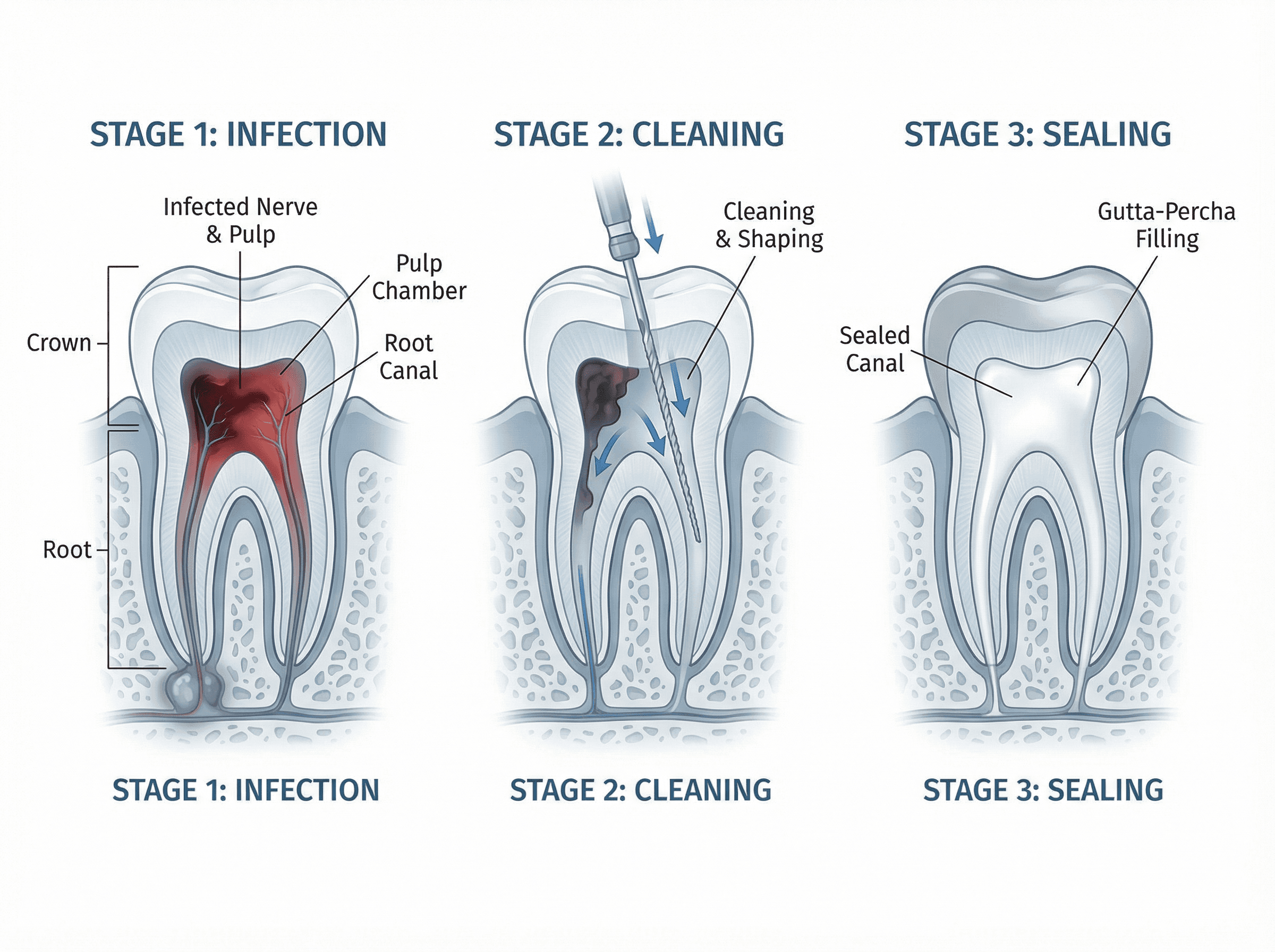
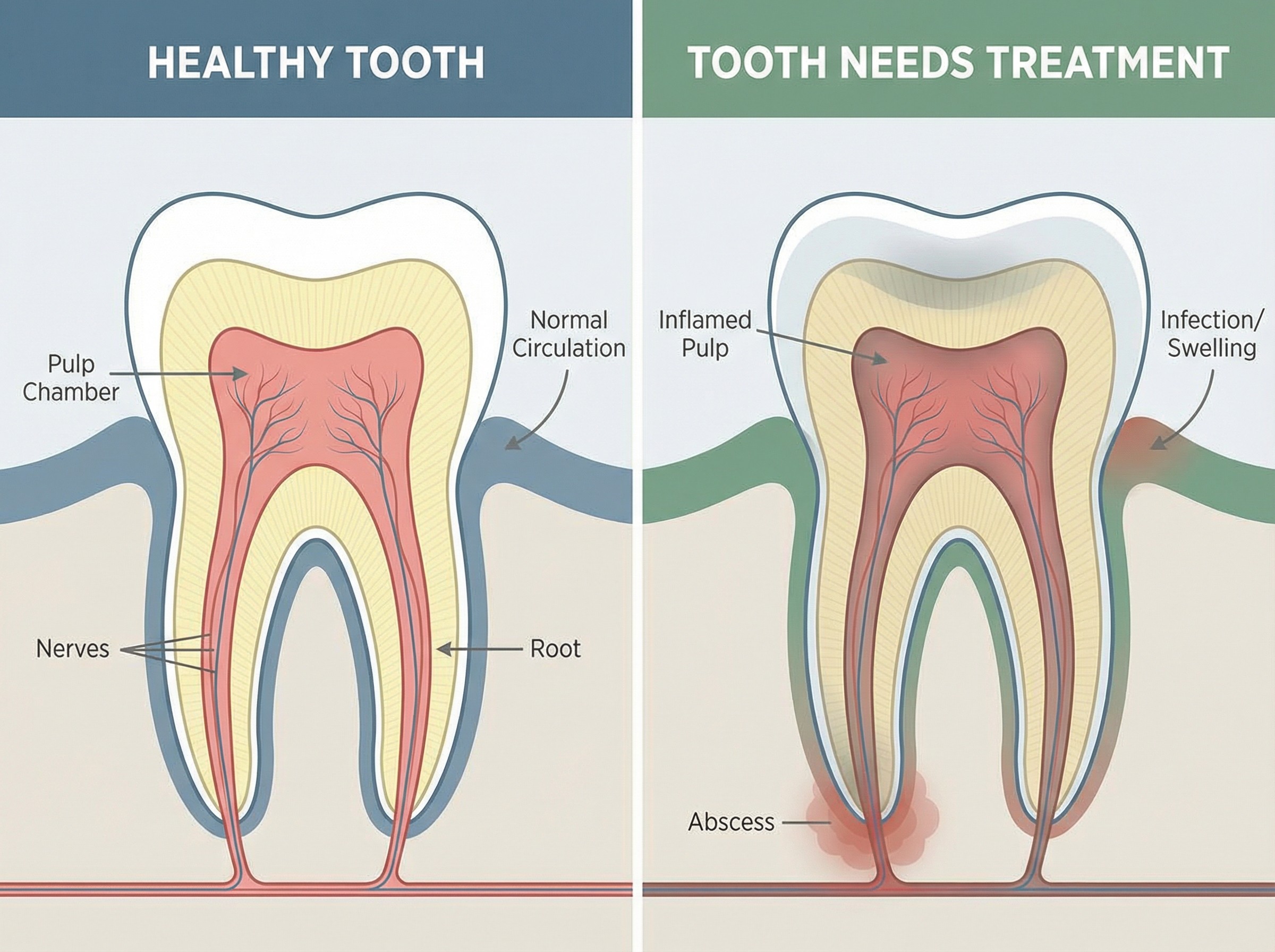
A root canal is a procedure where the dentist removes the infected or damaged nerve and pulp tissue inside your tooth (called the pulp chamber), cleans out the inside of the tooth, and then fills it with a special material to seal it. The tooth itself remains in your mouth, intact and functional. A root canal is necessary when the nerve inside your tooth becomes infected or inflamed due to deep decay, trauma, repeated dental procedures, or a crack or chip in the tooth.
You might think an infected nerve is a death sentence for the tooth, but it's not. Once the nerve tissue is removed and the tooth is cleaned and sealed, the tooth can function normally for decades. Yes, a tooth with a root canal is technically "dead" because it no longer has a living nerve, but it's still a functional, healthy tooth that can last the rest of your life.
The Root Canal Procedure: What to Expect
A root canal typically requires 1-2 appointments, depending on the complexity. During your appointment, you'll receive local anesthesia so you don't feel pain. The dentist then accesses the pulp chamber of your tooth and removes the infected or inflamed nerve tissue using specialized instruments. They then clean the inside of the tooth thoroughly to remove all bacterial contamination.
Next, the empty space inside the tooth is filled with a special rubbery material called gutta-percha, combined with a sealing cement. This fills the entire root canal system and prevents bacteria from re-entering. Finally, the access hole is filled with a tooth-colored resin material, and often a crown is recommended to protect the tooth long-term.
The entire appointment usually takes 1-2 hours. Most patients report that the procedure is far less painful than they expected. The local anesthesia prevents pain during the procedure. After anesthesia wears off, some mild sensitivity or soreness is normal for a few days. Over-the-counter pain relievers manage this easily.
Why Save Your Tooth with Root Canal?
Your natural teeth are superior to any replacement in several ways. First, natural teeth (including teeth that have had root canal treatment) have proprioception, meaning you can feel pressure and sensation through the root and bone. Replacement teeth like implants don't have this same sensory feedback, though implants come close. Dentures and bridges have even less sensory feedback.
Second, natural teeth preserve bone. When a tooth is extracted, the bone underneath begins deteriorating because there's no tooth root stimulating it. Over time, significant bone loss occurs, which changes your facial structure and can make future tooth replacement more difficult. A tooth with a root canal, even though the nerve is gone, still has its root intact and still stimulates the bone.
Third, natural teeth, once treated with a root canal, typically last for decades or even the rest of your life. The success rate for root canal treatment is around 85-95%, depending on the tooth and the specific circumstances. If a root canal fails, you still have options like retreat or extraction. But in most cases, a root canal is a permanent solution.
Finally, from a pure cost perspective, a root canal followed by a crown costs $1,500-$2,500 total. Extracting a tooth and replacing it with an implant costs $4,000-$6,000+, with bone grafting potentially adding another $500-$2,000. Over your lifetime, saving your tooth is almost always cheaper.
Root Canal Complications and Failures
Root canal failures do happen, though they're not common. A root canal can fail if the infection wasn't completely removed, if new infection enters through a crack or gap in the restoration, or if the filling material deteriorates over time. If a root canal fails, you'll experience symptoms similar to the original infection: pain, swelling, or sensitivity.
If a root canal fails, you have options. You can have the tooth retreated (the filling is removed and the tooth is cleaned again), which has a good success rate. Or you can have the tooth extracted and replaced. But most root canals succeed on the first try, and many last for life.
Understanding Tooth Extraction
What Happens During Tooth Extraction
Extraction is a surgical procedure where the tooth is removed from the socket in the bone. For a simple extraction, the dentist uses specialized tools to loosen the tooth and pull it out. For more complex cases (like impacted teeth or teeth with curved roots), a surgical extraction might be necessary, which requires an oral surgeon and may involve cutting bone or removing gum tissue.
Like root canal treatment, extraction uses local anesthesia so you don't feel pain during the procedure. After anesthesia wears off, you'll experience soreness and mild pain that typically lasts 3-7 days and is managed with over-the-counter pain relievers and ice.
Why Extraction Might Be Necessary
Sometimes extraction is truly the only option. If your tooth is severely cracked below the gumline, it can't be saved. If the root is severely fractured, root canal treatment won't help. If you have severe bone loss around the tooth, extraction might be necessary. If the tooth is severely decayed and there's not enough tooth structure remaining to hold a crown, extraction might be the best choice.
Your dentist (like Dr. Patrick) will only recommend extraction if your tooth truly cannot be saved. They won't extract a tooth just because it's faster or easier.
The Consequences of Extraction
Here's where extraction becomes complicated and expensive. Once your tooth is gone, you need to replace it. You have three options: a dental implant, a bridge, or a denture. Each has significant drawbacks compared to keeping your natural tooth.
A dental implant is the closest thing to a natural tooth, but it costs $4,000-$6,000 per tooth. If you have bone loss from the missing tooth, bone grafting adds another $500-$2,000. An implant also requires 3-6 months of healing before the final crown is placed. During this time, you either have a gap or wear a temporary tooth.
A bridge costs less than an implant ($1,500-$3,000) but requires shaving down the teeth on either side of the missing tooth to support the bridge. This means damaging two healthy teeth to replace one missing tooth. Bridges also require special flossing and can accumulate food underneath, leading to decay and gum disease.
A denture is the cheapest option ($500-$2,000) but requires special care, doesn't function like a natural tooth, and needs to be replaced every 5-8 years. Dentures also accelerate bone loss because they don't stimulate the underlying bone like a tooth root does.
Side-by-Side Comparison: Root Canal vs. Extraction
Cost Analysis
Root Canal Route: Root canal treatment costs $800-$1,500. A crown to protect the treated tooth costs $800-$2,000. Total: $1,600-$3,500. This is a one-time cost. The tooth should last decades or a lifetime.
Extraction + Implant Route: Extraction costs $100-$500. Dental implant placement costs $1,500-$2,500. Crown costs $1,000-$2,500. Total: $2,600-$5,500. And this might not be the end of the story. Implants occasionally need repairs or replacement.
Extraction + Bridge Route: Extraction costs $100-$500. Bridge costs $1,500-$3,000. Total: $1,600-$3,500. But you also need to maintain the bridge long-term, shaving down healthy neighboring teeth.
Extraction + Denture Route: Extraction costs $100-$500. Denture costs $500-$2,000. Replacement denture every 5-8 years costs another $500-$2,000. Over 20 years, you might spend $3,000-$6,000 on multiple dentures.
The cost advantage goes to root canal treatment. You pay less upfront and there's no ongoing cost.
Function and Quality of Life
A tooth with successful root canal treatment functions like a normal tooth. You can eat anything, brush it like a normal tooth, and it requires no special maintenance. Your quality of life is completely normal.
An implant functions almost like a natural tooth, but it has some limitations. It doesn't have proprioception like a natural tooth, so you can't feel pressure quite the same way. It requires careful maintenance and can occasionally develop issues.
A bridge compromises the health of two neighboring teeth and can develop problems at the junction where it meets the neighboring teeth.
A denture functions least like a natural tooth. It requires special care, has limitations on what you can eat, can shift or move, and requires ongoing adjustments.
Timeline and Recovery
A root canal takes 1-2 appointments and is done. Recovery is minimal, usually just mild soreness for a few days.
An extraction takes one appointment, but if you're replacing the tooth with an implant, you're looking at 3-6 months of healing before the implant is ready for the crown. A bridge can be placed after the extraction site heals, usually within 1-2 weeks. A denture can sometimes be made immediately after extraction.
Common Questions About Root Canals and Extractions
Myth: "Root canals are extremely painful"
The Truth: This is one of the most common misconceptions. Root canals have a reputation for being painful, but this reputation is outdated. Modern root canal procedures use local anesthesia just like a filling, so you don't feel pain during the procedure. You feel pressure and vibration, but not pain. The tooth is already inflamed and painful before the root canal. After the procedure, that pain is gone. Most patients feel relieved after a root canal.
The pain reputation comes from the infection in the tooth, not the root canal treatment itself. The root canal actually relieves the pain you've been experiencing.
Question: "If I have a root canal, will my tooth eventually need extraction anyway?"
The Answer: Not necessarily. Many root canal-treated teeth last for decades or even a lifetime. Success rates for root canal treatment are 85-95%, which means most root canals succeed long-term. If a root canal does fail (which is uncommon), you have options like retreatment before considering extraction. The tooth isn't doomed to eventual extraction just because it had a root canal.
Myth: "Extraction is the simpler solution"
The Truth: Extraction might seem simpler in the moment, but it creates downstream complications. You're left with a missing tooth that needs replacement. Every replacement option (implant, bridge, denture) is more complex and expensive than saving your original tooth with a root canal. Extraction is the "easy" short-term choice that creates long-term problems.
Question: "What if I extract a tooth and never replace it?"
The Answer: Your remaining teeth will shift to fill the gap, leading to bite problems and alignment issues. The bone underneath the missing tooth will deteriorate, changing your facial structure and potentially making you look older. Your remaining teeth can develop decay or gum disease more easily because the pressure distribution is uneven. Not replacing a missing tooth is generally not a good long-term strategy.
Myth: "A tooth with a root canal is 'dead' and will eventually fail"
The Truth: A tooth with a root canal is no longer alive in the sense that it has no living nerve, but it's still a healthy, functional tooth. It's not "dead" and it's not doomed to failure. Thousands of teeth with root canal treatment from 20, 30, or 40 years ago are still functioning perfectly today. "Dead" is a misleading term that creates unnecessary anxiety.
Question: "If a root canal fails, can I just extract the tooth then?"
The Answer: Yes. If a root canal fails (which is rare), and retreatment isn't successful or isn't something you want to pursue, extraction is an option. You're not locked into keeping a failed tooth forever. But the point is that trying to save your tooth first with a root canal is almost always the right call because most root canals succeed.
Question: "Are there alternatives to root canal and extraction?"
The Answer: Not really. If the nerve inside your tooth is infected or inflamed, it must either be removed (root canal) or the entire tooth must be extracted. There's no middle ground. Some patients ask about medications or antibiotics to save the tooth without removing the nerve, but this doesn't work. Once the nerve is infected, the only treatments are root canal or extraction.
Making Your Decision: Root Canal or Extraction
The decision between root canal and extraction is one of the most important decisions you'll make about your dental health. But here's the guidance that almost all modern dentists will give you: try to save your tooth first. Your natural teeth, even teeth that have needed root canal treatment, are almost always better than any replacement option.
Root canal treatment preserves your natural tooth, preserves the underlying bone, maintains your facial structure, and keeps your bite balanced. It's also the most cost-effective long-term solution. Extraction might seem easier or faster, but it creates downstream complications that will cost more money and cause more problems down the road.
That said, every tooth is different. Some teeth truly can't be saved. Your specific tooth and your specific situation might call for extraction. The only way to know for sure is to have a thorough evaluation by a dentist you trust. Dr. Kanchwala, Dr. Thobhani, and Dr. Patrick will assess your tooth and give you honest recommendations based on what's best for your long-term oral health, not what's most convenient or profitable.
Schedule your consultation with Smyrna Dental Studio to discuss whether your tooth can be saved with root canal treatment or whether extraction is truly necessary. Call or book online. We're located at 4480 N Cooper Lake Rd SE, Suite 210, Smyrna, GA 30082. We serve patients throughout Smyrna, Marietta, Vinings, and Cobb County.
Why Choose Smyrna Dental Studio for Root Canal Treatment?
Dr. Thobhani and Dr. Patrick have extensive experience with root canal treatment and understand the detailed requirements for success. They're skilled at treating complex cases that might be referred out by less experienced dentists. Dr. Kanchwala's gentle approach means anxious patients feel comfortable during treatment, and sedation options are available if needed. Most importantly, our team will be honest with you about whether your tooth can be saved. We don't recommend extraction just because it's simpler. We fight to save your tooth whenever possible. Let's discuss your options and help you make the right decision for your smile.