What Are the Alternatives to Dental Crowns? A Honest Guide for Patients
TLDR (Too Long; Didn't Read)
Crown alternatives include: inlays and onlays (for moderate damage), large composite fillings (minor-to-moderate decay), veneers (cosmetic concerns only), and dental bonding (minor chips or gaps). Each option works for specific situations, they are not interchangeable with crowns. Some teeth are too damaged or structurally compromised for any alternative, and a crown remains the most durable long-term solution in those cases. If you're unsure which path is right for your tooth, book an evaluation at Smyrna Dental Studio and get a straight answer.
You Were Told You Need a Crown - But Are There Other Options?
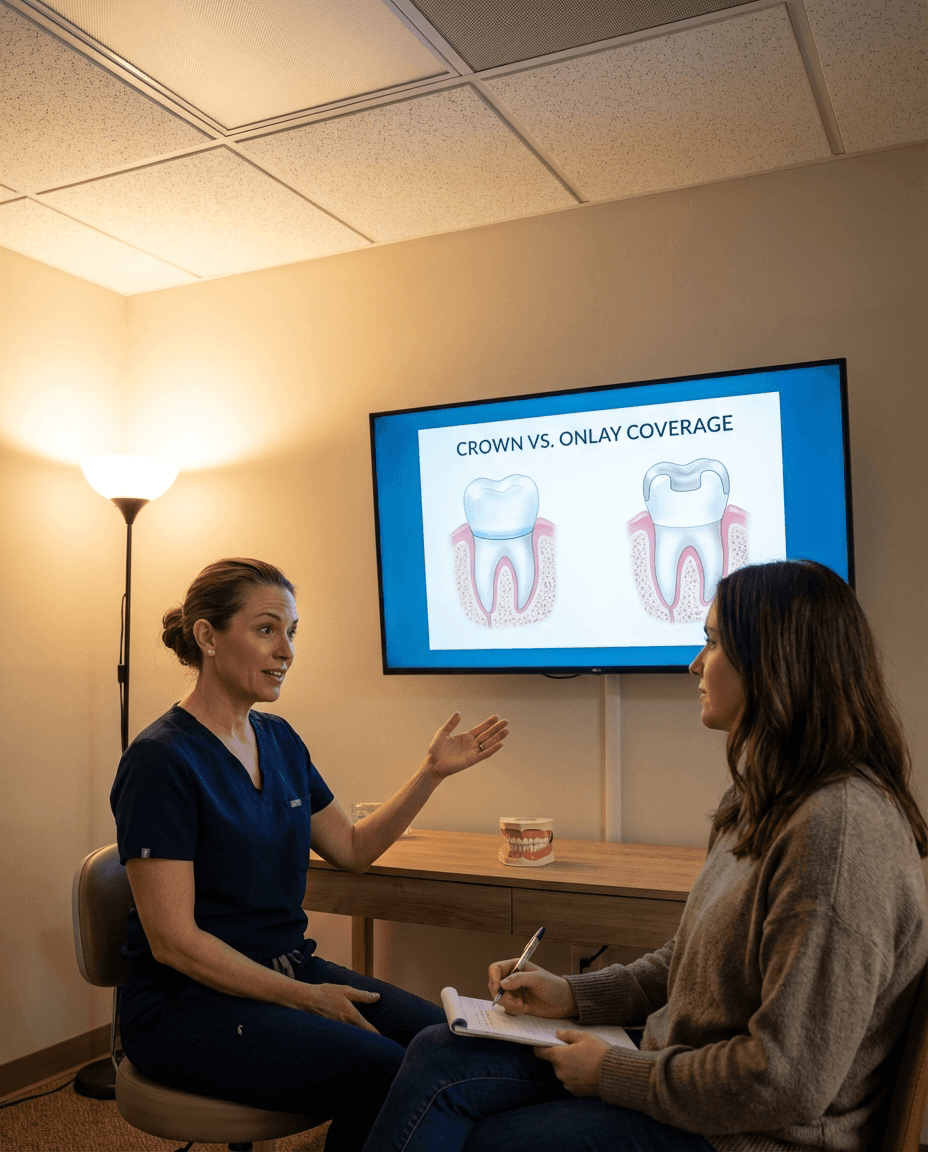
It's a fair question to ask. A crown is a significant investment of time and money, and it permanently alters your natural tooth. Before committing, it makes sense to understand whether a less invasive treatment could solve the same problem. The honest answer is: sometimes yes, sometimes no, and the difference comes down to how much healthy tooth structure remains and what's actually causing the damage.
This guide walks through the real alternatives to dental crowns, explains when each one is a legitimate option, and tells you plainly when a crown is the only treatment that will hold up over time. There's no upselling here, just the clinical reasoning your dentist uses to make that call. Understanding it puts you in a better position to have an informed conversation at your next appointment.
Crown Alternatives That Actually Work, and When to Use Them
Inlays and Onlays (Partial Crowns)
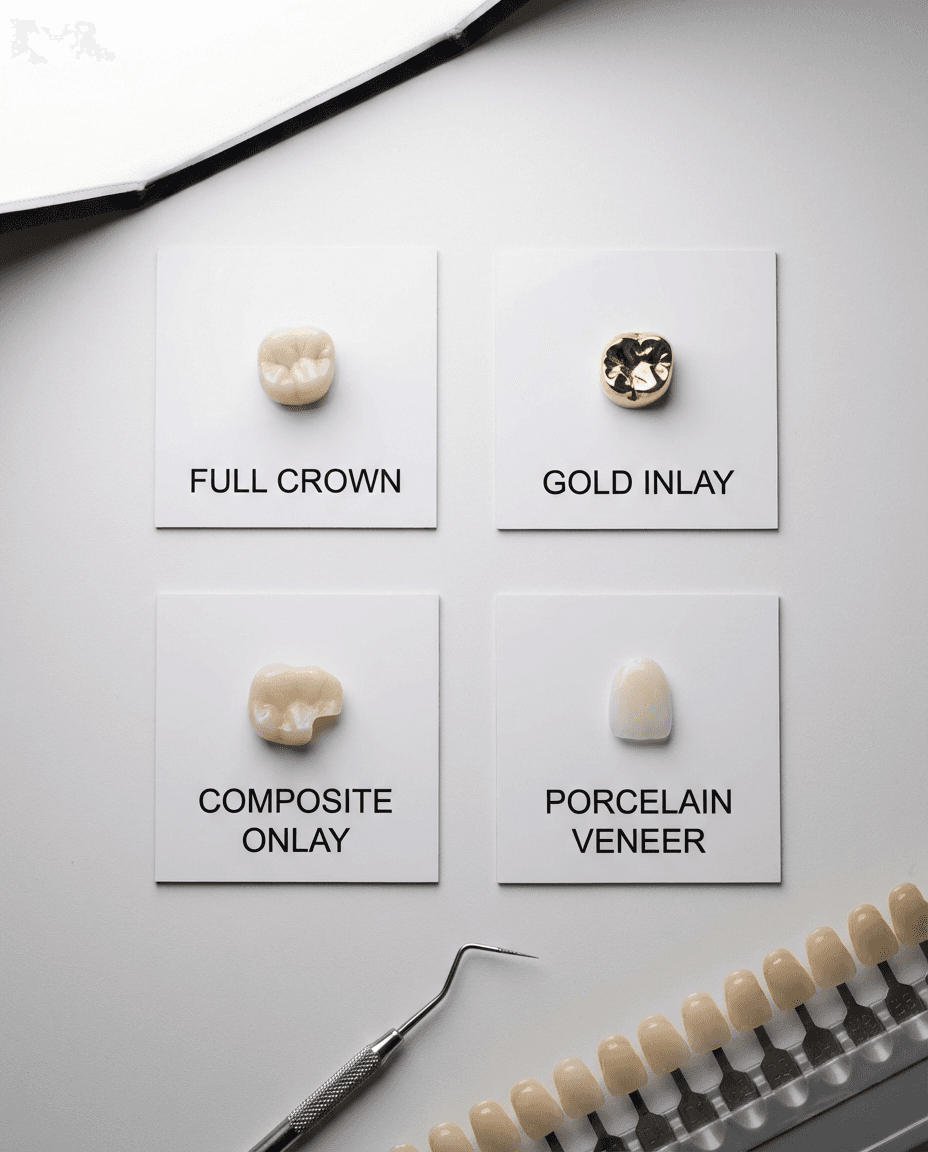
Inlays and onlays are the closest true alternative to a crown. An inlay fills damage confined to the central chewing surface of a molar. An onlay extends over one or more of the tooth's cusps. Both are fabricated in a dental lab from porcelain or gold and bonded permanently into place. They restore strength and function while preserving significantly more of your natural tooth than a full crown requires. Inlays and onlays are appropriate when decay or a fracture is too large for a standard filling but doesn't extend far enough to justify capping the entire tooth. They typically last 10-30 years with proper care, comparable to a crown, and they're often less expensive because less tooth reduction is involved.
Large Composite Resin Fillings
Composite resin fillings can address moderate decay or a small fracture when enough healthy tooth structure remains to support the material. Modern composites bond directly to tooth enamel and dentin, allowing a dentist to remove only the damaged portion without reshaping the whole tooth. The trade-off is durability: composite wears faster than porcelain or metal, and large composite restorations in back teeth are under significant biting pressure. For minor-to-moderate damage, a well-placed composite is a reasonable choice. For damage involving multiple surfaces or a tooth that has already had a large filling, the material may not hold long enough to justify the cost of placement, and an onlay or crown will serve you better.
Dental Veneers
Veneers are thin porcelain or composite shells bonded to the front surface of a tooth. They're a crown alternative only in a narrow cosmetic context, discoloration that doesn't respond to whitening, minor chips on front teeth, or small gaps between teeth. Veneers don't restore structural strength. A tooth with significant decay, a crack that extends into the dentin, or damage on multiple surfaces is not a candidate for a veneer. Attempting to use a veneer on a structurally compromised tooth often results in failure and can leave the tooth worse off. If your concern is primarily appearance and the underlying tooth is healthy, a veneer is a legitimate and conservative option.
Dental Bonding
Dental bonding uses composite resin applied directly to the tooth surface, shaped by hand, and hardened with a curing light. It's the least invasive option on this list, no lab work, no tooth reduction beyond removing decay, and often completed in a single visit. Bonding works well for minor chips, small cosmetic irregularities, and closing slight gaps between front teeth. It's more affordable upfront than veneers or crowns. The limitation is longevity: bonding typically lasts 3-7 years on front teeth and less on back teeth under heavier bite forces. It stains more easily than porcelain and can chip. For minor issues on front teeth, bonding is a solid starting point, just understand it's likely a temporary-to-medium-term solution rather than a permanent fix.
When There Is No Good Alternative to a Crown
Some clinical situations genuinely don't have a better option. Understanding them helps you evaluate your own case more clearly.
After a Root Canal
A tooth that has undergone root canal treatment loses its internal blood supply and becomes brittle over time. Without a crown to protect and reinforce it, the tooth is at high risk of fracturing, often at or below the gumline, which can mean extraction. Back teeth, which absorb the most biting force, almost always require a crown after a root canal. Front teeth with minimal remaining structure do as well. This isn't upselling; it's protecting the investment you've already made in saving the tooth.
Severely Cracked or Fractured Teeth
A cracked tooth that extends into the dentin or approaches the pulp requires a crown to hold the two halves together under chewing force. No filling or bonding material can replicate that mechanical function. If a crack is left untreated or treated with an insufficient restoration, normal chewing pressure will propagate the crack further, potentially splitting the tooth entirely or allowing bacteria to reach the pulp, which leads to infection. The sooner a crack is treated with a crown, the better the prognosis for keeping the tooth.
Teeth with Large Existing Restorations
A tooth that already has a large filling, particularly one covering multiple surfaces, often doesn't have enough remaining healthy enamel and dentin to support another filling. When more than roughly half of a tooth's structure has been replaced by restorative material, the remaining walls become thin and prone to fracture. Attempting another filling in this situation can cause the wall of the tooth to break off, turning a manageable problem into an emergency. A crown in this scenario is structural protection, not an upgrade.
Severe Wear from Bruxism
Patients who grind or clench their teeth heavily (bruxism) can wear enamel down to the point where the tooth height is significantly reduced and bite function is affected. Composite bonding and veneers won't survive the forces a bruxism patient generates. Crowns, particularly full-coverage porcelain-fused-to-metal or zirconia crowns, are durable enough to restore proper tooth height and function in these cases, especially when paired with a custom night guard to protect the investment.




Frequently Asked Questions About Crown Alternatives
Q: Can a large filling replace a crown?
A: Sometimes, but not always. Large composite fillings work for moderate decay when enough healthy tooth remains. When damage covers multiple surfaces or the tooth has already had large restorations, a filling won't provide adequate structural support, and an onlay or crown is the more reliable long-term option.
Q: Is an onlay significantly cheaper than a crown?
A: Onlays typically cost less than full crowns because less tooth reduction is involved and less material is used. The exact difference depends on the material chosen and your insurance coverage. Your dentist can give you a direct cost comparison once they've assessed the tooth and confirmed which treatment applies.
Q: Can I get a veneer instead of a crown on a back tooth?
A: No, veneers are designed for the front surfaces of anterior (front) teeth. Back teeth absorb heavy biting forces that a veneer cannot withstand. Applying a veneer to a molar or premolar would almost certainly result in failure. Back teeth with structural damage need a filling, onlay, or crown depending on severity.
Q: What happens if I delay getting a crown my dentist recommended?
A: The underlying problem, a crack, decay, or weakened walls, will worsen with continued use. A tooth that could have been saved with a crown can fracture to the gumline, develop an infection, or require extraction if treatment is delayed long enough. The cost and complexity of treatment almost always increases with delay.
Q: How do I know which option is right for my tooth?
A: The decision depends on clinical factors only visible through examination and X-rays: how much healthy tooth structure remains, whether the pulp is affected, the location of the damage, and your bite forces. There's no reliable way to self-diagnose this, a proper evaluation by a dentist is the only accurate path to a recommendation.
Common Myths vs. The Truth About Avoiding Crowns
Myth: Dentists recommend crowns because they're more profitable.
Truth: Crown recommendations are driven by clinical necessity, not revenue. A crown requires significantly more chair time than a filling. Placing an inadequate restoration that fails quickly creates liability and damages patient trust. When a dentist recommends a crown over a simpler option, it's because the simpler option won't hold up in that specific clinical situation.
Myth: If the tooth doesn't hurt, it doesn't need a crown.
Truth: Pain is a poor indicator of structural damage. A cracked tooth or a tooth with deep decay can be pain-free right up until it fractures or develops an abscess. Structural integrity, not pain level, determines whether a crown is necessary. Many teeth that need crowns feel completely fine until something goes wrong.
Myth: Getting a crown means losing most of your natural tooth.
Truth: Crown preparation removes the outer layer of the tooth, typically 1-2 millimeters, to create room for the crown to fit without altering your bite. The root and the bulk of the tooth remain intact. An onlay removes even less. Modern preparation techniques are conservative, and the goal is always to preserve as much healthy structure as possible.
Myth: Dental bonding is just as durable as a crown for back teeth.
Truth: Composite bonding lasts 3-7 years under normal conditions and significantly less under the bite forces that back teeth experience. Crowns made from zirconia or porcelain-fused-to-metal routinely last 15-25 years on posterior teeth. Bonding has real advantages for front teeth with minor damage, but durability on a heavily loaded molar isn't one of them.
Frequently Asked Questions: Alternatives to Dental Crowns
Q: What are the best alternatives to dental crowns?
A: Common alternatives include dental bonding, inlays, and onlays, depending on your dental needs.
Q: Is dental bonding a good alternative to crowns?
A: Dental bonding can be a good alternative for minor repairs or cosmetic improvements, but may not be as durable as a crown for larger restorations.
Q: How do I know which alternative is right for me?
A: Schedule a consultation at Smyrna Dental Studio to get a personalized recommendation based on your dental health and goals.
The right choice between a crown and an alternative depends entirely on your tooth's specific condition - how much healthy structure remains, where the damage is, and what your tooth has to withstand every day. Inlays, onlays, composite fillings, veneers, and bonding are all legitimate treatments in the right circumstances. They're not workarounds or second-best options when they're correctly indicated. But when a crown is genuinely what a tooth needs, no alternative will hold up as well over time. The most useful thing you can do right now is get an honest evaluation so you know exactly what you're dealing with. Dr. Natasha Kanchwala, Dr. Leslie Patrick, and Dr. Raheel Thobhani at Smyrna Dental Studio provide straightforward assessments of damaged teeth and will walk you through every option that applies to your situation, including when a less invasive route is a real possibility. Book your appointment online at Smyrna Dental Studio today.