How Do Dentists Prep Teeth for a Crown? A Step-by-Step Patient Guide
TLDR (Too Long; Didn't Read)
Crown prep involves four main steps: the dentist numbs the tooth with a local anesthetic, removes a thin layer of enamel (roughly 1.5–2mm) to make room for the crown, takes a digital scan or impression of the prepared tooth, then places a temporary crown to protect it while your permanent crown is made. The prep appointment typically takes 60–90 minutes. You'll return one to three weeks later to have the permanent crown cemented. Book your appointment online at Smyrna Dental Studio.
Wondering What Actually Happens During Crown Prep? Here's the Full Picture
Being told you need a dental crown raises an immediate question for most patients: "What are they actually going to do to my tooth?" It's a fair question, and it deserves a clear, honest answer — not a vague reassurance. Crown preparation is a well-defined process with specific steps, and understanding those steps before you sit in the chair makes a real difference in how relaxed you feel throughout the appointment.
The short version: your dentist numbs the area completely, reshapes the tooth so the crown can fit over it, takes precise measurements of the prepared tooth, and covers it with a temporary crown while the permanent one is custom-made. Each of those steps has a purpose, and none of them should feel mysterious. Let's walk through the whole appointment — from the first injection to the moment you walk out with your temporary crown in place.
What Happens During the Crown Prep Appointment, Step by Step
The crown prep appointment is the first and more involved of the two visits required for a traditional crown. According to the American Dental Association, dental crowns are among the most performed restorative procedures in the U.S., and the prep process follows a consistent, predictable sequence regardless of which tooth is being crowned. Here's what each phase actually involves.
Step 1: Numbing the Tooth with Local Anesthetic
Before anything touches your tooth, the dentist numbs the area with a local anesthetic — typically lidocaine or a similar agent. Most dentists first apply a topical numbing gel to the gum so the injection itself is barely noticeable. The anesthetic takes full effect within five to ten minutes. Once it does, you'll feel pressure during the procedure but not pain. If you feel any sharpness at any point, raise your hand — adding more anesthetic mid-appointment is completely routine.
Step 2: Removing a Thin Layer of Enamel (Tooth Reduction)
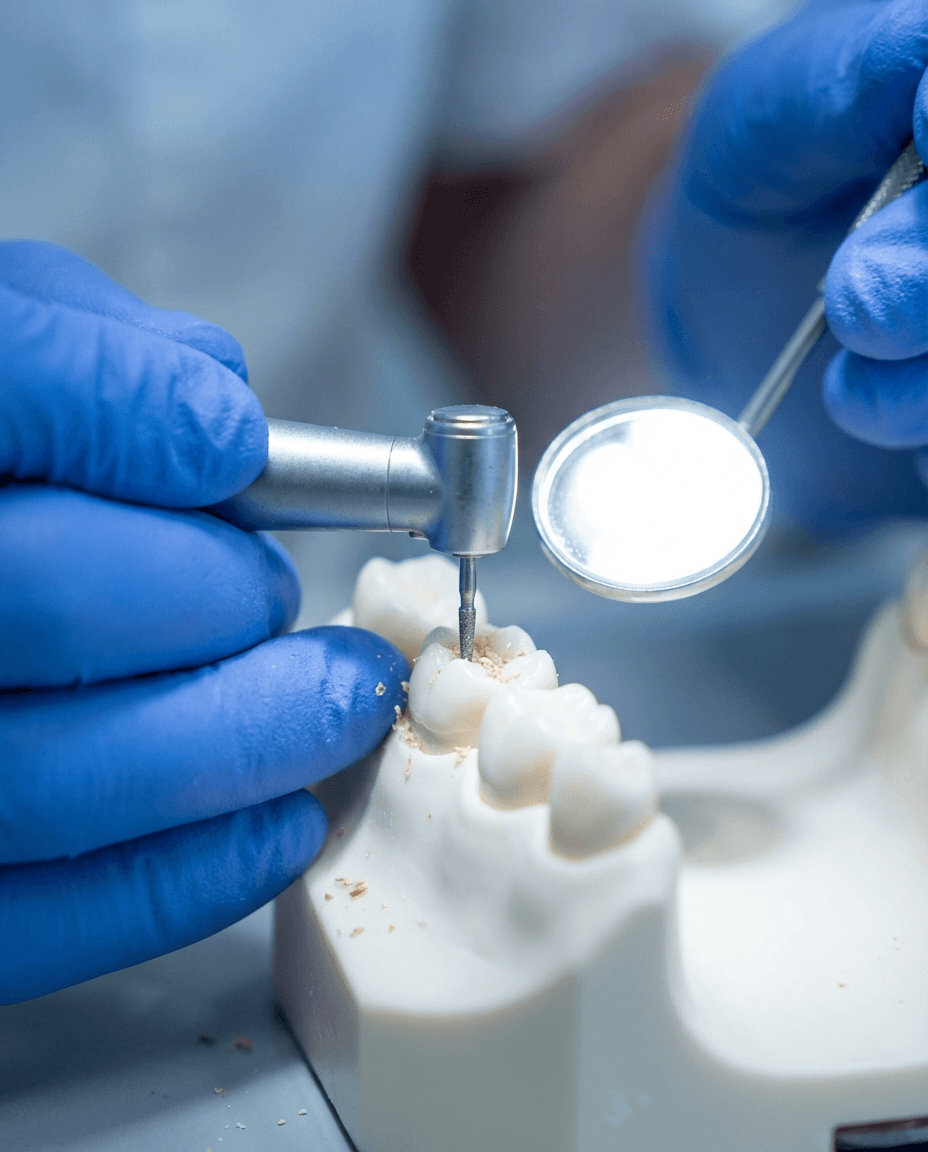
This is the core of crown prep. Your dentist uses a dental drill to remove approximately 1.5–2mm of enamel from the outer surface of the tooth — enough to create space for the crown to sit over the tooth without making your bite feel uneven or bulky. The amount removed depends on the crown material. Porcelain crowns typically require slightly more reduction than metal crowns because the material needs adequate thickness to be both strong and natural-looking.
If the tooth has a large existing filling, significant decay, or has been cracked, the dentist may also need to build up the tooth's core before shaping it. This core build-up uses composite resin or another restorative material to create a stable foundation so the crown has something solid to grip. A build-up adds roughly 15–20 minutes to the appointment and is determined beforehand when possible, though sometimes it's only confirmed once the tooth is examined up close.
Step 3: Taking an Impression or Digital Scan
Once the tooth is shaped, your dentist needs an exact record of it — along with the surrounding teeth and your bite — so the lab can fabricate a crown that fits precisely. There are two ways this is done. Traditional impressions use a putty-like material that's placed in a tray over your teeth and held for a couple of minutes until it sets. Digital scanning uses a small handheld wand to capture a 3D image of your teeth in minutes, with no trays or putty required.
Digital scanning is increasingly common because it's faster, more comfortable, and produces highly accurate measurements that translate directly into a precise crown. The scan or impression is then sent to a dental lab — or, in offices with in-house milling technology, used to fabricate a same-day crown. For traditional lab-made crowns, the lab typically needs one to three weeks to fabricate and return the finished crown.
Step 4: Placing the Temporary Crown
Before you leave, your dentist places a temporary crown over the prepared tooth. Temporary crowns are usually made from acrylic or composite resin and are cemented with a softer, temporary adhesive so they can be removed easily at your next visit. They protect the shaped tooth from sensitivity and physical damage, keep the surrounding teeth from shifting, and let you chew and speak normally while you wait.
The temporary is shaped and trimmed to match your bite, which takes roughly 10–15 minutes. It won't look quite as polished as your permanent crown, but it functions well for the interim period. At the end of this step, your prep appointment is complete. Total chair time for most patients: 60–90 minutes.
What Should You Expect While Wearing a Temporary Crown?
The period between your prep appointment and your permanent crown placement — typically one to three weeks — is straightforward for most patients. Temporary crowns are designed to function comfortably, but they do require a bit more care than your natural teeth or a permanent crown.
Sensitivity Is Normal, Especially in the First Few Days
Once the local anesthetic wears off — usually two to four hours after your appointment — you may notice the prepared tooth and surrounding gum feel tender. This is a normal response to the reshaping process. Mild temperature sensitivity, especially to cold, is also common while wearing a temporary. Over-the-counter ibuprofen or acetaminophen, taken as directed, handles the discomfort well for most patients. If sensitivity is sharp or worsening after the first week, contact your dentist.
Foods to Avoid with a Temporary Crown
Temporary crowns are held in place with a weaker cement than the permanent crown will be, so certain foods put them at risk. Avoid sticky foods like caramel, gummy candies, and chewy bread, which can pull the temporary loose. Also stay away from very hard foods — ice, hard nuts, crusty bread — that could crack the acrylic. On the opposite side of your mouth, you can eat normally. If your temporary crown does come off before your next appointment, call your dental office right away — the tooth needs to be covered to prevent shifting and sensitivity.
Keep the Area Clean, but Floss Carefully
Brushing normally is fine and important. When flossing next to the temporary crown, slide the floss out to the side rather than snapping it up through the contact — that snapping motion can dislodge the temporary cement. Rinsing with a gentle saltwater solution can help keep the gum tissue comfortable if it's tender from the preparation work. Your permanent crown placement visit will be noticeably shorter and simpler than the prep appointment — usually 45–60 minutes to remove the temporary, check the permanent crown's fit, adjust the bite, and cement it in place.
Frequently Asked Questions About Crown Preparation
Q: Does crown prep hurt?
A: Not during the procedure. The tooth is numbed with a local anesthetic before any drilling begins, so what you'll feel is pressure and vibration — not pain. The gum and tooth may feel tender once the numbing wears off, but that soreness is mild for most patients and resolves within a few days with over-the-counter pain relievers.
Q: How much of my tooth does the dentist actually remove during prep?
A: Typically 1.5–2mm of enamel from the outer surfaces of the tooth. The exact amount depends on the crown material being used — all-porcelain crowns require slightly more reduction than metal or porcelain-fused-to-metal crowns. Your dentist removes only what's necessary to ensure the crown fits and functions properly.
Q: Can I eat before my crown prep appointment?
A: Yes — you should eat a full meal before your appointment. The local anesthetic will leave your mouth numb for two to four hours afterward, which makes eating uncomfortable and increases the risk of accidentally biting your cheek or tongue. Having a good meal beforehand means you won't need to eat until the numbness has fully faded.
Q: What happens if my temporary crown falls off?
A: Call your dental office as soon as possible. The prepared tooth underneath is more sensitive and vulnerable without coverage, and the surrounding teeth can begin to shift within days. Your dentist will re-cement the temporary or fit a new one. Don't leave the tooth uncovered — and keep the temporary if you can find it.
Q: How long does the permanent crown last after all this prep work?
A: With proper care, dental crowns last an average of 10–15 years, and many last significantly longer. The lifespan depends on the material, bite forces, and how well you maintain oral hygiene around the crown. Brushing, flossing, and regular dental checkups are the most important factors in making a crown last.
Common Myths vs. The Truth About Crown Prep
Myth: The dentist grinds your tooth down to a tiny nub.
Truth: The amount of tooth removed is precise and minimal — roughly 1.5–2mm of enamel from the outer surfaces. The bulk of the tooth structure remains intact. The reshaping creates a tapered shape that lets the crown fit snugly over the tooth like a cap, not a post. Your dentist removes only what the crown material requires.
Myth: You'll be in pain for days after crown prep.
Truth: Mild soreness for one to three days is normal, but most patients manage it comfortably with over-the-counter pain relievers like ibuprofen or acetaminophen. Significant or worsening pain beyond the first week is not typical and warrants a call to your dentist — but for the majority of patients, the recovery is far milder than expected.
Myth: The temporary crown is just a placeholder that doesn't matter.
Truth: The temporary crown does real work. It protects the shaped tooth from sensitivity, bacterial exposure, and physical damage. It also keeps neighboring teeth from drifting into the open space, which would compromise how the permanent crown fits. Treating your temporary well — avoiding sticky and hard foods — directly affects how smoothly your permanent crown placement goes.
Myth: Once a tooth is prepped for a crown, it's too weak to survive without one.
Truth: A tooth that's been prepped but never crowned isn't ideal — the reduced enamel makes it more vulnerable — but it's not structurally ruined. That said, completing the crown process is always the right call. The whole reason for recommending a crown is to restore and protect a tooth that's compromised. Leaving the process unfinished defeats that purpose entirely.
Crown preparation is a well-practiced, predictable procedure — and understanding exactly what's going to happen makes the whole experience significantly less intimidating. Your dentist numbs the area, carefully reshapes the tooth, captures precise measurements, and sends you home with a temporary crown while your permanent one is crafted. It takes about an hour and a half, it's far more comfortable than most patients anticipate, and the result is a tooth that's protected and restored for years to come. If you've been told you need a crown, or if you're experiencing a cracked, painful, or heavily filled tooth and want to find out if a crown is the right solution, Dr. Natasha Kanchwala, Dr. Leslie Patrick, and Dr. Raheel Thobhani at Smyrna Dental Studio will walk you through every step of the process before anything happens. Book your appointment online at Smyrna Dental Studio today.