Dental Bridge Cost Smyrna GA - Fixed Bridge Pricing & Alternatives
TLDR (Too Long; Didn't Read)
Dental bridges cost $1,500-$3,500 per bridge depending on materials and complexity. They're fixed tooth replacements held by crowns on the teeth adjacent to the missing tooth. Bridges are faster and cheaper than implants but require shaving down healthy neighboring teeth, which is a permanent modification. Implants cost more ($4,000-$6,000) but preserve neighboring teeth and last longer. For single missing teeth, implants are usually better. For multiple adjacent missing teeth, bridges might make sense. Bridges last 5-15 years. Implants last 20+ years. Smyrna Dental Studio offers both options and helps you choose what's best for your situation.
Ready to start? Schedule your consultation today for a personalized smile design.
Dental Bridges in Smyrna: When This Tooth Replacement Option Makes Sense
You're missing one or more teeth, and you're exploring replacement options. Your dentist has mentioned both implants and bridges. You're trying to understand the difference, which option is better, and which is more affordable. It's confusing because both are legitimate options with real advantages and disadvantages.
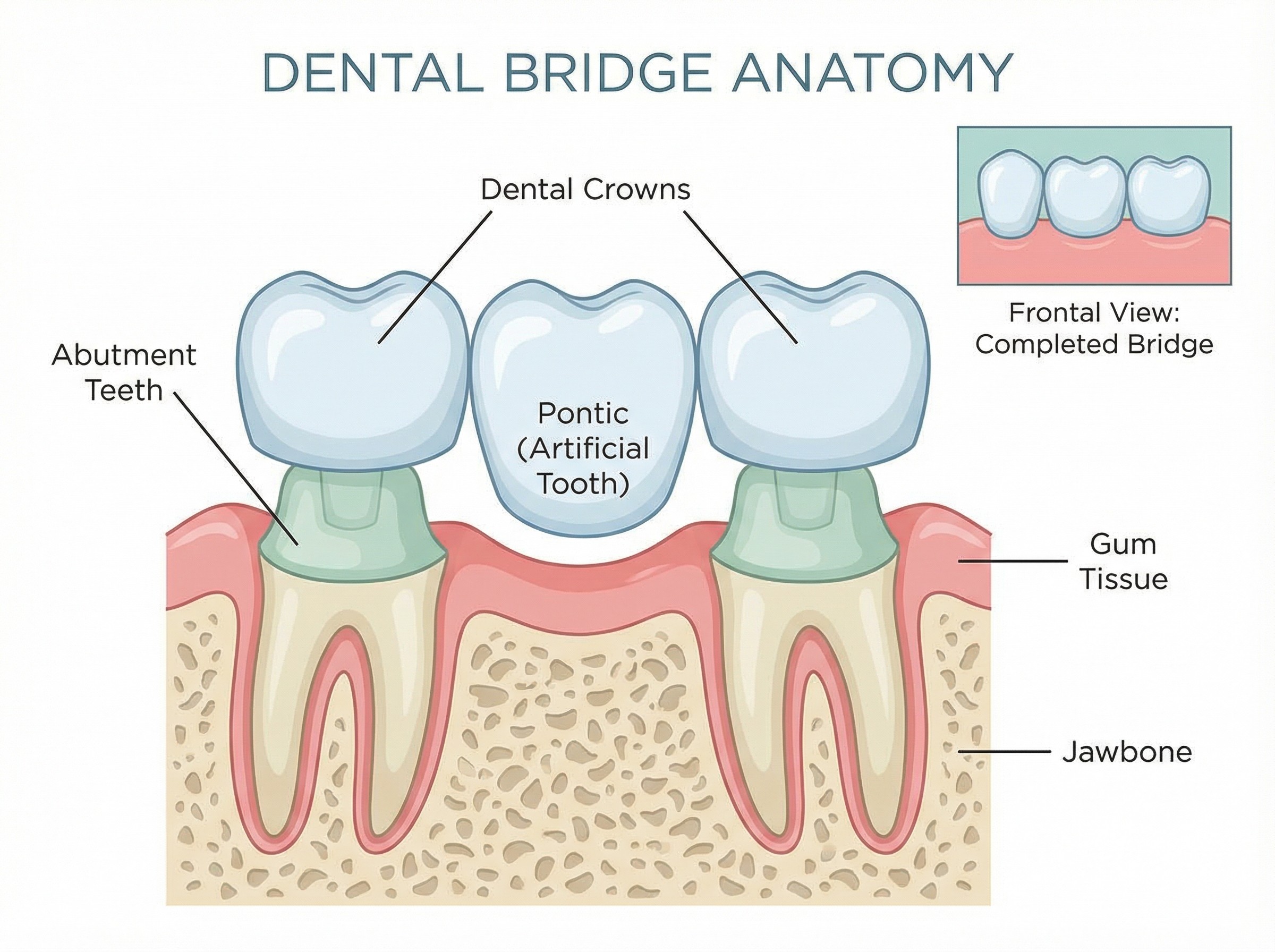
A dental bridge is a fixed tooth replacement where crowns are placed on the teeth adjacent to the gap, and artificial teeth are suspended between those crowns, bridging the gap. It's a time-tested solution that's been used for decades. It's also faster and cheaper than implants. But it comes with tradeoffs that you need to understand before deciding.
The decision between a bridge and an implant depends on your specific situation: how many teeth are missing, the health of your neighboring teeth, your budget, and your long-term preferences. At Smyrna Dental Studio, Dr. Kanchwala, Dr. Thobhani, and Dr. Patrick will help you understand both options so you can make an informed decision. Let's explore what bridges are, how much they cost, and how they compare to implants. Schedule a consultation to discuss your tooth replacement options.

What Is a Dental Bridge?
How a Dental Bridge Works
A dental bridge consists of artificial teeth (called pontics) suspended between and anchored to natural teeth or implants (called abutment teeth). When you have one or more missing teeth, a bridge fills that gap by connecting to the teeth on either side.
Here's how it works: Your dentist removes decay and shapes the teeth adjacent to the gap (abutment teeth) to accommodate crowns. Crowns are placed on both abutment teeth. A bridge of artificial teeth is then attached between the crowns, suspended over the gap where your natural teeth were missing. The result is a fixed replacement that looks like natural teeth and functions almost like natural teeth.
Types of Bridges
Traditional Bridge: This is the most common type. It has crowns on both sides (abutment teeth) with artificial teeth suspended between. It's strong and reliable. It requires healthy teeth on both sides of the gap.
Cantilever Bridge: This has crowns on only one side. It's used when there's only one abutment tooth available. It's less stable than traditional bridges and is only appropriate for small gaps.
Maryland Bridge: This uses a metal or resin framework bonded to the back of abutment teeth rather than full crowns. It's less invasive than traditional bridges. It's less durable and usually temporary.
Implant Bridge: This uses one or more implants as abutment teeth instead of natural teeth. It's the most expensive option but doesn't sacrifice natural teeth.
Cost of Dental Bridges
What's Included in Bridge Pricing
A dental bridge typically costs $1,500-$3,500 depending on materials and complexity. This includes the cost of shaping and preparing abutment teeth, creating crowns, creating the pontic (artificial tooth/teeth), and the labor to fit and bond everything.
For a single missing tooth with two abutment teeth, expect $2,000-$3,000. For multiple adjacent missing teeth, the cost might increase proportionally.
Factors Affecting Bridge Cost
Materials: Bridges can be made from different materials. Metal-ceramic (porcelain-fused-to-metal) is affordable and durable. Full ceramic or zirconia is more esthetic and might cost more. Your choice of material affects price.
Number of Teeth: A single-tooth bridge costs less than a multi-tooth bridge because it requires less custom fabrication.
Location: Front-tooth bridges are more esthetically demanding and might cost more than back-tooth bridges.
Abutment Tooth Health: If abutment teeth have existing decay or damage, restoring them before bridge placement increases cost.
Dental Bridge vs. Implant: The Real Comparison
Cost Comparison
Dental Bridge: $2,000-$3,000. Usually one-time cost. Replacement needed every 5-15 years.
Dental Implant: $4,000-$6,000. One-time investment that usually lasts 20+ years.
Over 20 years: Bridge might cost $6,000-$9,000 (initial plus one or two replacements). Implant costs $4,000-$6,000 total with minimal maintenance. Long-term, implants are comparable or cheaper.
Function Comparison
Bridges: Fixed and stable once placed. You chew with normal function. However, because there's no tooth root under the pontic, bacteria and food can accumulate underneath, requiring special care.
Implants: Feel completely like natural teeth. No special care needed. Chewing function is identical to natural teeth. Implants stimulate underlying bone, preserving jaw structure.
Tooth Sacrifice Comparison
Bridges: Require removal of healthy tooth structure from abutment teeth to accommodate crowns. This is permanent. Even if you later want an implant, you still have crowns on abutment teeth.
Implants: No healthy tooth structure is sacrificed. Your natural teeth stay natural. You're replacing only the missing tooth.
Longevity Comparison
Bridges: Average lifespan is 5-15 years depending on care. Some last 20+ years, but 10 years is typical.
Implants: Average lifespan is 20-30+ years. Many implants last a lifetime.
Esthetic Comparison
Bridges: Look natural when well-made. The junction where the bridge meets abutment crowns can be visible in some cases. Bone loss over time (because there's no root stimulation under the pontic) can make the bridge look less natural.
Implants: Look completely natural. No junctions visible. Underlying bone is preserved, so long-term esthetics improve rather than decline.
When a Bridge Makes Sense
Bridges Are Better If:
You have multiple adjacent missing teeth (a bridge distributes load better than multiple individual implants). You can't afford implants right now but want a fixed solution (bridges are cheaper upfront). You need a replacement quickly (bridges take 2-3 weeks; implants take 4-6 months). Your abutment teeth already have crowns and don't need additional modification. You have medical conditions that make implant surgery risky.
Implants Are Better If:
You're missing a single tooth (no healthy teeth sacrificed, superior esthetics, better long-term value). You want to preserve all your natural teeth. You want a solution that will last 20+ years without replacement. You can afford the upfront cost and can wait 4-6 months for treatment. You want bone preservation and better long-term facial structure.




Common Questions About Dental Bridges
Myth: "A dental bridge is as good as an implant for a single missing tooth"
The Truth: For a single missing tooth, implants are generally superior. An implant preserves your natural teeth (you don't have to crown the neighboring teeth). Implants preserve bone underneath. Implants have better long-term esthetics and function. A bridge requires sacrificing two healthy teeth and has a shorter lifespan. For single missing teeth, implants are the better choice if you can afford them.
Question: "Can I get a bridge if I'm missing teeth on only one side?"
The Answer: Yes, with a cantilever bridge, which is anchored to only one abutment tooth. However, cantilever bridges are less stable and less ideal than traditional bridges because all the chewing force is on one side. They're typically used only when no other option exists.
Question: "How long does a bridge last?"
The Answer: A well-maintained bridge typically lasts 5-15 years. Some last 20+ years. When a bridge fails, it usually needs to be completely replaced. Unlike an implant, you can't repair just one component. The entire bridge needs replacement.
Question: "Can I floss under a bridge?"
The Answer: Partially. You can floss around the abutment crowns like normal teeth, but you need special floss (like threader floss) to clean under the pontic. Food accumulates under bridges more than under natural teeth, so special care is necessary to prevent decay and gum disease.
Myth: "Bridges don't require any special care"
The Truth: Bridges require careful cleaning, special flossing, and excellent home care to prevent decay under the bridge and around the abutment teeth. They also require professional cleanings and monitoring. If decay develops under a bridge, the entire bridge usually needs replacement.
Question: "What happens if an abutment tooth gets a cavity?"
The Answer: This is a significant problem. If decay develops under an abutment crown, the bridge must be removed, the decay treated, a new crown placed, and a new bridge fabricated. This defeats the purpose of a bridge and can be more expensive than simply replacing the bridge.
Question: "Can a bridge be replaced with an implant later?"
The Answer: Yes, but it requires additional work. You'd have the bridge removed, the abutment teeth restored or crowned differently, and an implant placed in the original missing tooth location. You don't recover the healthy tooth structure that was removed for the original bridge.
Making the Bridge vs. Implant Decision
Choosing between a bridge and an implant is a significant decision that affects your oral health long-term. Both are viable options, but they're appropriate for different situations. For single missing teeth, implants are almost always the better choice. For multiple adjacent missing teeth, bridges might make sense. Your specific situation, your budget, and your long-term preferences all factor in.
The best approach is to consult with a dentist who understands both options and can honestly recommend what's best for you, not what's most profitable. Dr. Kanchwala, Dr. Thobhani, and Dr. Patrick at Smyrna Dental Studio will assess your teeth, discuss your situation, and recommend the option that gives you the best long-term outcome.
Schedule a consultation to discuss your tooth replacement options. We'll explain bridges and implants, discuss the pros and cons of each for your specific situation, and help you make an informed decision. We're located at 4480 N Cooper Lake Rd SE, Suite 210, Smyrna, GA 30082, and we serve patients throughout Smyrna, Marietta, Vinings, and Cobb County. Contact us today to learn more.
Why Choose Smyrna Dental Studio for Tooth Replacement?
We specialize in helping patients understand all their options. Dr. Kanchwala's gentle approach means you're comfortable discussing your concerns. Dr. Thobhani educates patients so you truly understand the implications of each choice. Dr. Patrick brings expertise in both bridge and implant dentistry and can execute either option with precision. Most importantly, we recommend what's best for your long-term health and happiness, not what's most convenient or profitable for us. Let's discuss your tooth replacement options and find the solution that's right for you.