Dental Implant Cost in Smyrna, GA: Single Tooth to All-on-6
The short answer: what dentures, implants and All-on-4 cost in Georgia
CareCredit (2026) averages $2,022 for a regular denture, MetLife (2025) lists $3,000 to $6,000 per implant, and Pearl (May 2026) lists $16,405 to $29,529 per Georgia All-on-4 arch.
Dentures: CareCredit's 2026 study averages $2,022 for a regular full denture and $2,243 for an immediate one.
Single tooth: $3,000 to $6,000 for the post, abutment and crown together. A quote near $2,100 may cover the post alone.
Snap-on denture: about $3,500 to $20,000 per arch depending on source and implants (one 2026 guide lists $3,500 to $12,000, while our Smyrna cost guide lists $7,000 to $20,000).
All-on-6: about $3,000 to $8,000 more per arch than All-on-4 in one 2026 national guide.
Add-ons (Pearl, May 2026 Georgia averages): about $254 per simple extraction, $1,014 for a bone graft and $2,187 for a sinus lift.
These are third-party ranges, not Smyrna Dental Studio fees. Your exact price is set after an exam and a 3D scan. Dental plans typically cap benefits at $1,000 to $2,000 a year, so financing and pre-tax funds matter.

Price is the most common reason people hesitate, so here are all of the numbers
Cost is one of the most common questions people ask about implants, and quotes from different offices can be hard to compare. This guide lays out what dentures, a single implant, a bridge, a snap-on denture, All-on-4, All-on-6 and a full mouth typically cost in published Georgia and national data, what is and is not included, and what you can do to pay for it. We see patients from Smyrna, Vinings, Mableton, Marietta and Austell, and every figure here is a range from a third-party source, not a Smyrna Dental Studio price, because your bone, teeth and materials set your real number. Where a 2026 source exists we use it, and every figure carries the year of its data.

Published prices run from about $2,000 per arch for a denture to well over $60,000 for a full mouth
Regular and immediate dentures are the lowest-cost step at about $2,000 per arch
CareCredit's 2026 national cost study puts a full traditional denture at an average of $2,022 (range $1,493 to $3,309), $1,927 in Georgia, and a full immediate denture at $2,243 (CareCredit). Delta Dental's published 2024 averages are $1,115 to $2,425 for a full lower and $1,220 to $2,540 for a full upper (Delta Dental). An immediate denture is placed the day your remaining teeth are removed, so you are never without teeth, but it fits less precisely at first and is usually relined or remade after about six months, which is charged separately (University of Iowa). A regular denture is made after your gums heal. These averages usually do not include the exam, X-rays or extractions, which CareCredit lists separately. Dentures cost the least up front, but they need relines and eventual replacement: Cleveland Clinic says most dentures last at least seven years, while our full denture page says 5 to 7 years. See our guide to the best dentures for how immediate, regular, snap-on and All-on-4 options compare.
A snap-on denture adds implants and costs roughly $3,500 to $20,000 per arch depending on the source
A snap-on denture locks onto implants, usually two on the lower jaw and four or more on the upper, and still comes out for cleaning. CareCredit's 2026 study lists snap-on dentures at an average of $2,540 but does not say what that includes, so treat it as the denture component. Published all-in figures vary widely: one 2026 guide puts quotes at $3,500 to $7,500 per arch with two implants and $6,000 to $12,000 with four (RealDentalCosts), our Smyrna implant cost guide lists implant-supported dentures at $7,000 to $20,000 depending on complexity, and our implant-supported denture article lists $8,000 to $14,000. Low figures often leave out surgery, extractions or grafts. See our implant-supported dentures page.
A single dental implant costs about $3,000 to $6,000 complete
MetLife breaks a complete single implant into three parts: the post at $1,000 to $3,000, the abutment at $500 to $1,000, and the crown at $800 to $3,000, for a typical $3,000 to $6,000 total (MetLife, September 2025). Delta Dental lists a similar $2,800 to $5,600 for a single implant without dental benefits, based on its 2022 data (Delta Dental). Be careful with very low numbers. CareCredit's 2023 to 2024 national study found the implant post alone averaged $2,143, with the crown billed on top (CareCredit), so a quote near $2,100 may cover only the post.
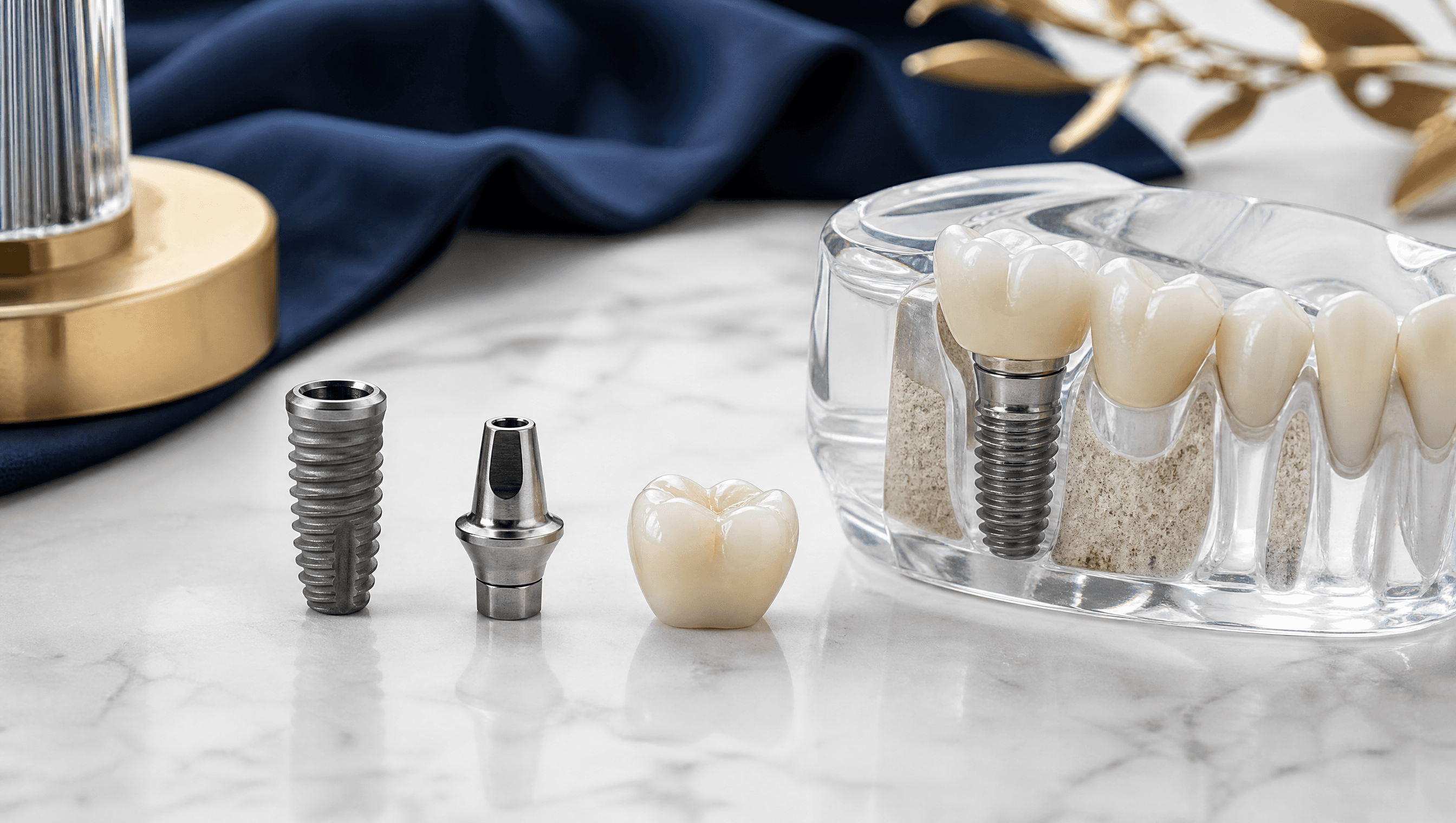
Two or three missing teeth often need two implants and a bridge, not three implants
Replacing a short span does not always need one implant per tooth. A three-tooth gap can sometimes be restored with two implants supporting a bridge, and CareCredit's 2024 study average for an implant-supported bridge was $5,195. For comparison, Pearl's May 2026 Georgia data put a conventional three-unit bridge at an average of $4,474 (Pearl). The number of implants and the material change the total, so ask for the plan in writing.
All-on-4 in Georgia is published at about $16,405 to $29,529 per arch
Pearl's May 2026 fee data, based on ADA fee survey data, puts Georgia All-on-4 at $16,405 to $29,529 per arch, with an average near $21,873 (Pearl), and its Atlanta page lists $17,160 to $28,600. CareCredit's 2024 study average was lower at $15,176 nationally, and our own implant cost guide lists $15,000 to $30,000 per arch. A bundled full-arch quote may include the 3D scan, extractions if needed, the implants, same-day temporary teeth, sedation, follow-up visits and the final bridge, but Pearl notes the final zirconia bridge and sedation are often billed separately from the surgical fee, so confirm what a quote bundles. Doubling Pearl's Georgia per-arch range for both jaws gives roughly $32,800 to $59,100, or about $43,700 at the average, which is our arithmetic, not a quoted price. Read more on our All-on-4 cost page.
All-on-4 is one option for some denture wearers, and it is not right for everyone
If you wear dentures and a lower denture keeps slipping, a snap-on denture on two implants is often the first step to ask about, and All-on-4 is another to compare if you want fixed teeth. All-on-4 is surgery, and bone, gum health, smoking and diabetes decide whether it fits, so we cover who qualifies, the risks and the research in our guide to the best dentures and in All-on-4 versus traditional dentures.
All-on-6 typically adds about $3,000 to $8,000 per arch over All-on-4
All-on-6 uses six implants for added support. One published 2026 comparison puts All-on-6 at $24,000 to $38,000 per arch, about $3,000 to $8,000 more than All-on-4 (RealDentalCosts). That is a national estimate built on a different All-on-4 baseline than the Georgia figures above, so use it for the size of the gap, not as a Georgia price. See All-on-6 versus All-on-4.
A full mouth of individual implants can exceed $60,000
Replacing every tooth with its own implant is the highest tier, and MetLife cites $60,000 or more. Ranges vary widely because some quotes mean two All-on-4 arches while others mean up to 28 separate implants. See our full-mouth implants page and our comparison of full-mouth implants versus dentures.
Add-on costs for extractions, grafts, sinus lifts and sedation change your final number
The base fee is rarely the whole story. Pearl's May 2026 Georgia averages are about $254 for a simple extraction (Pearl), $1,014 for a bone graft (Pearl), $2,187 for a sinus lift (Pearl) and $497 for sedation (Pearl). Extraction prices are per tooth, and surgical and multiple extractions cost more. A 3D CBCT scan is listed at $300 to $600 in RealDentalCosts' 2026 guide, and DentistryIQ's 2023 breakdown lists a scan at $250 to $400 and a temporary tooth at $250 to $750 (DentistryIQ), so ask what your consultation includes. Pearl notes Georgia averages track close to national averages.
This is why a 3D scan comes first. Bone grafts and sinus lifts depend on what the scan shows, and the implant planning at our practice starts there. Dr. Raheel Thobhani, DMD, leads implant and reconstruction work at our practice, and after your consultation we give you a written treatment plan and cost breakdown so you know what is included and what is not.
Two quotes can be thousands of dollars apart because they include different things
Most gaps come from what is included, not from the implant itself. A low quote is often just the post. Graft, sedation, extraction, 3D imaging, the temporary tooth and the final crown may all be separate. DentistryIQ, written by a practicing dentist, warns that an unusually low advertised price can be misleading for exactly this reason.
Before you compare, ask each office for a written, itemized quote that lists the scan, extraction, graft, post, abutment, crown, temporary tooth and sedation. Delta Dental also suggests requesting a pre-treatment estimate from your insurer. Materials, lab quality, the number of implants and your own bone all move the number. We accept most major PPO dental insurance plans and file claims on your behalf, and your plan makes the final payment decision. Our guide to the cheapest dental implants available in Smyrna explains what to watch for in low quotes.
Dental insurance usually caps implant coverage at $1,000 to $2,000 a year
Dental plans cap benefits and often apply waiting periods
Most dental plans cap benefits at $1,000 to $2,000 a year (healthinsurance.org, November 2025). A PPO may cover around 50% of an implant, though waiting periods and exclusions vary. See our guide on whether implants are covered by insurance.
Original Medicare does not cover implants, and Medicaid benefits vary by state
Original Medicare generally does not cover implants, dentures or routine dental care (Medicare.gov). KFF reports that 98% or more of individual Medicare Advantage plans offer some dental benefit in 2026, usually with an annual dollar cap (KFF), so check your plan's Evidence of Coverage. Medicaid dental benefits for adults vary by state and plan and often exclude implants, so ask your plan before scheduling.
HSA, FSA and the medical deduction may help, but not for everyone
IRS Publication 502 lets you deduct medical and dental expenses above 7.5% of your adjusted gross income if you itemize, and it includes amounts paid for artificial teeth (IRS). The deduction only helps if your total itemized deductions exceed your standard deduction, and you cannot deduct amounts reimbursed by insurance or paid with HSA or FSA funds, so many people will not benefit. HSA and FSA dollars are generally usable for medical care such as implants, but confirm with your plan administrator and ask a tax professional.
Financing spreads the cost, but it is still a loan
Cherry financing lets you see monthly payment options with a soft check that, per Cherry, does not affect your credit score. If you accept a plan it is a loan, so ask for the APR, total repayment cost, promotional-rate terms and late fees before you sign. Our guide on how people afford All-on-4 implants walks through combining insurance, financing and pre-tax funds, and if cost is the barrier right now, see our guide to dental work with no money.
Implants can be worth the cost over decades, but they are not risk-free
Cleveland Clinic, in a page updated June 2026, says implants can often last a lifetime with good care, while most crowns and bridges last around 15 years and most dentures last at least seven years, though this varies, and our full denture page says 5 to 7 years on average (Cleveland Clinic). A 2019 review of 18 studies found about 96.4% implant survival at ten years, falling to 93.2% when missing data were accounted for (Howe et al., 2019). The crown on top can need repair or replacement sooner than the implant itself, and a 2025 systematic review of 102 studies found about 21% of patients develop peri-implantitis, an infection around the implant (J Periodontol, 2025), so cleanings and home care matter.
Over 20 years you might replace a denture two or three times (three at the CareCredit average is about $6,100, our arithmetic) and a bridge about once, but implants also carry later costs for crown or bridge replacement, cleanings and treating gum infection, so ask for each option priced over time. Delta Dental also notes that the teeth on either side of a bridge need restoration even when they are healthy (Delta Dental). Our comparison of implants versus dentures covers the trade-offs in detail.
Waiting or going abroad can change the price and the risk
After a tooth is lost, the jawbone gradually shrinks, which can make a later graft or sinus lift more likely. Those add costs that average $1,014 and $2,187 in Georgia, per Pearl's May 2026 data. Waiting is not always more expensive, but it rarely makes the case simpler. If you have swelling, fever, a bad taste or severe pain, call us right away at (770) 863-0005. If swelling is spreading on your face or neck, you have trouble swallowing or breathing, you cannot open your mouth, or you have fever with facial swelling, go to the ER or call 911.
Dental tourism can look cheaper. The CDC notes that dental care is the most common form of medical tourism among U.S. residents, that complications are most often infections, and that some overseas offices charge substantial fees for follow-up care (CDC). Add travel and any rework to the comparison.



Dental implant and denture cost questions answered, from one tooth to a full arch
How much do dental implants cost in Smyrna, GA?
Published ranges put a complete single dental implant at about $3,000 to $6,000 (MetLife, September 2025) and a Georgia All-on-4 arch at $16,405 to $29,529 (Pearl, May 2026). These are third-party ranges, not Smyrna Dental Studio fees, and our own Smyrna cost guide lists single implants at $3,500 to $6,000. We give you a written treatment plan and cost breakdown after your consultation.
How much do dentures cost compared with implants?
Dentures cost less up front. CareCredit's 2026 study averages $2,022 for a regular full denture and $2,243 for an immediate one, versus $3,000 to $6,000 for one implant and about $21,873 for an All-on-4 arch in Georgia. Dentures need relines and replacement over time, so the gap narrows with the years.
How much does a single dental implant cost?
A complete single dental implant typically costs $3,000 to $6,000, covering the post, abutment and crown. MetLife lists the post at $1,000 to $3,000, the abutment at $500 to $1,000 and the crown at $800 to $3,000. Extractions, grafts and sedation are often extra.
Why are dental implants so expensive?
Dental implants cost more because you are paying for surgery plus a custom lab-made tooth. There are three parts, plus 3D imaging, planning and sometimes a graft. An implant also replaces the root, which a bridge or denture does not, so it is built to last decades rather than years.
Is there a cheaper alternative to a dental implant?
Yes, a cheaper alternative exists, with trade-offs. A three-unit bridge averages about $4,474 in Georgia in Pearl's May 2026 data but needs neighboring teeth reshaped, and a full denture averages $1,927 in Georgia in CareCredit's 2026 study. Cleveland Clinic says most bridges last around 15 years, and dentures typically last 5 to 10 years depending on the source.
Are dental implants worth the cost?
For many patients, dental implants are worth it. About 93% to 96% of implants are still in place after ten years (Howe et al., 2019), and Cleveland Clinic says they can often last a lifetime with good care. About one in five patients develops peri-implantitis, so cleanings and home care matter.
Are mini implants cheaper and just as good?
Mini implants are not always just as good. A 2024 meta-analysis of five randomized trials in lower-denture patients found mini implant survival of 89% to 98%, versus 99% to 100% for standard implants, though follow-up was 12 months or less. They may suit some lower-denture cases, so ask what the evidence says for you.
Can I get All-on-4 if I wear dentures, and what would it cost?
Many denture wearers can be evaluated for All-on-4, and a snap-on denture is the middle step to compare. Candidacy depends on bone, gum health and general health. In Georgia, Pearl's May 2026 data put All-on-4 at $16,405 to $29,529 per arch, versus about $1,927 for a regular denture in CareCredit's 2026 study.
Is All-on-4 cheaper than individual implants?
Per arch, All-on-4 is usually cheaper than a full set of individual implants. Georgia All-on-4 is published at $16,405 to $29,529 per arch in Pearl's May 2026 data, while a full mouth of single implants can exceed $60,000. The trade-off is a fixed bridge on four implants, so candidacy and your bone matter.
How much does All-on-6 cost compared with All-on-4?
All-on-6 typically costs about $3,000 to $8,000 more per arch than All-on-4 because it uses two additional implants. One published 2026 national guide puts All-on-6 at $24,000 to $38,000 per arch. Extra implants can add stability, and your scan shows whether you need them.
What is the cost per tooth for a full arch?
A single implant is about $3,000 to $6,000 per tooth, while a full arch replaces 10 to 14 teeth for about $16,405 to $29,529, which works out to roughly $1,170 to $2,950 per tooth. That per-tooth figure is our arithmetic, not a quoted price, and a full arch is a different treatment from single implants.
What is included in a dental implant quote?
A complete single-tooth implant quote covers the post, abutment and crown. A full-arch quote may cover the 3D scan, extractions, implants, temporary teeth, sedation, follow-ups and final bridge. Always ask what is not included, such as grafts, sinus lifts, extractions and sedation, and ask for the quote in writing.
Why do two offices quote different prices for implants?
Two offices quote different implant prices because their quotes usually include different things. One office may bundle the scan, extraction and temporary tooth while another bills each separately. Materials, lab quality, the number of implants and location also differ, so compare itemized written quotes, not totals.
Will my dental insurance pay for implants?
Dental insurance may pay part of an implant, but rarely all of it. Plans typically cap benefits at $1,000 to $2,000 a year, coinsurance is often 50%, and waiting periods may apply. Some plans exclude implants entirely, so ask your insurer for a pre-treatment estimate before you start.
Does Medicare cover dental implants?
Original Medicare does not cover dental implants, dentures or routine dental care. KFF found 98% or more of individual Medicare Advantage plans offer some dental benefit in 2026, but each has an annual dollar cap and implant coverage varies. Check your plan's Evidence of Coverage or call the plan before scheduling treatment.
Can I deduct dental implants on my taxes?
You may be able to deduct dental implants, but it helps only some people. If you itemize, IRS Publication 502 lets you deduct medical and dental expenses above 7.5% of your adjusted gross income, including artificial teeth. Purely cosmetic work is excluded, and HSA or FSA funds cannot also be deducted.
Can I get dental implants with a payment plan?
Dental implants can often be paid through a payment plan. Financing through Cherry lets you spread the cost into monthly payments, and checking options uses a soft credit check per Cherry. Accepting a plan is a loan, so ask for the APR and total cost, and combine it with insurance and HSA or FSA funds.
What happens if I wait to replace a missing tooth?
If you wait to replace a missing tooth, the jawbone gradually shrinks, which can make a later graft or sinus lift more likely and raise the cost. Neighboring teeth can also shift. A scan shows the current state of your bone, and swelling, fever or severe pain means you should call right away.
A clear price starts with a scan, not a guess
The honest answer to "how much will my implants cost" is a range now and a firm number after your exam. If you have been collecting quotes, bring them in. We will help you compare what each one includes, and if something looks unusually low, we will tell you what is probably missing.
Get a written implant treatment plan in Smyrna
Book your consultation online or call (770) 863-0005. You will meet the team on our team page, and after your consultation we give you a written treatment plan and cost breakdown. Learn more about dental implants at Smyrna Dental Studio, read our Georgia implant pricing guide, or check monthly options with Cherry.
This guide is general information, not a substitute for a dental exam. Costs are ranges and vary by case.
Written by Blake Hundley. Last updated October 2026.