How Do People Afford All-on-4 Implants? 6 Real Strategies
TL;DR: How Do People Actually Afford All-on-4?
Most patients afford All-on-4 by combining 3 to 4 funding sources at once: HSA/FSA pre-tax savings (22 to 37% off), Cherry financing for the balance (no credit-score impact), insurance benefits applied to extractions and imaging, and phasing the upper and lower arches across two calendar years.
Stacked strategy beats any single option: The patients we see comfortably affording All-on-4 use 3 or more funding sources, not one.
HSA 2026 limit: $4,300 individual / $8,550 family. Tax savings of 22-37% depending on bracket.
FSA 2026 limit: $3,300 per year (use-it-or-lose-it).
Cherry financing: Splits the remaining balance into fixed monthly payments with no credit-score impact at application.
Two-year phasing: Doing the upper arch in December and lower in January doubles your FSA deployment.
Average All-on-4 cost (industry): $11,640 to $27,500 per arch. Smyrna Dental Studio publishes our exact breakdown openly during consultation.
The honest playbook for affording full-arch implants
When patients walk into our Smyrna consultation worried about cost, the conversation almost always starts the same way: "I priced this at another office and it was $30,000. There's no way I can write that check." The honest answer we give every time is that almost nobody pays for All-on-4 with a single check. The patients who actually move forward use a stacked strategy of insurance, tax-advantaged accounts, financing, and timing. Our team at Smyrna Dental Studio walks every patient across Smyrna, Marietta, and Sandy Springs through the exact math at the consultation. Here are the six strategies that, combined, make this procedure genuinely affordable for most working families.

Strategy 1: HSA and FSA tax savings (the most underused option)
If you have a Health Savings Account or Flexible Spending Account through your employer, the IRS classifies dental implants as a qualified medical expense. Per guidance compiled by implant education resources, the 2026 HSA limit is $4,300 for individuals and $8,550 for families, while the FSA limit is $3,300 per year. The tax math is the most underused leverage in this whole conversation: at a 32% marginal tax rate, $5,000 of HSA money saves you $1,600 in taxes, which effectively reduces your out-of-pocket cost to $3,400. We have patients who fund 25 to 35% of their entire All-on-4 case purely through pre-tax dollars they were going to lose anyway.
Strategy 2: Cherry financing for the remaining balance
Once HSA, FSA, and insurance contributions are stacked, most patients have a remaining balance of $8,000 to $18,000. That is where Cherry financing becomes the practical answer. Cherry splits the balance into fixed monthly payments with no impact on your credit score at application, and the application itself takes about two minutes during your consultation. Unlike CareCredit, Cherry does not have the deferred-retroactive-interest trap (published financing breakdowns explains this risk in detail) where missing the promotional window triggers 26.99% APR back-applied to the original loan.

Strategy 3: Apply insurance to the preliminaries (every dollar counts)
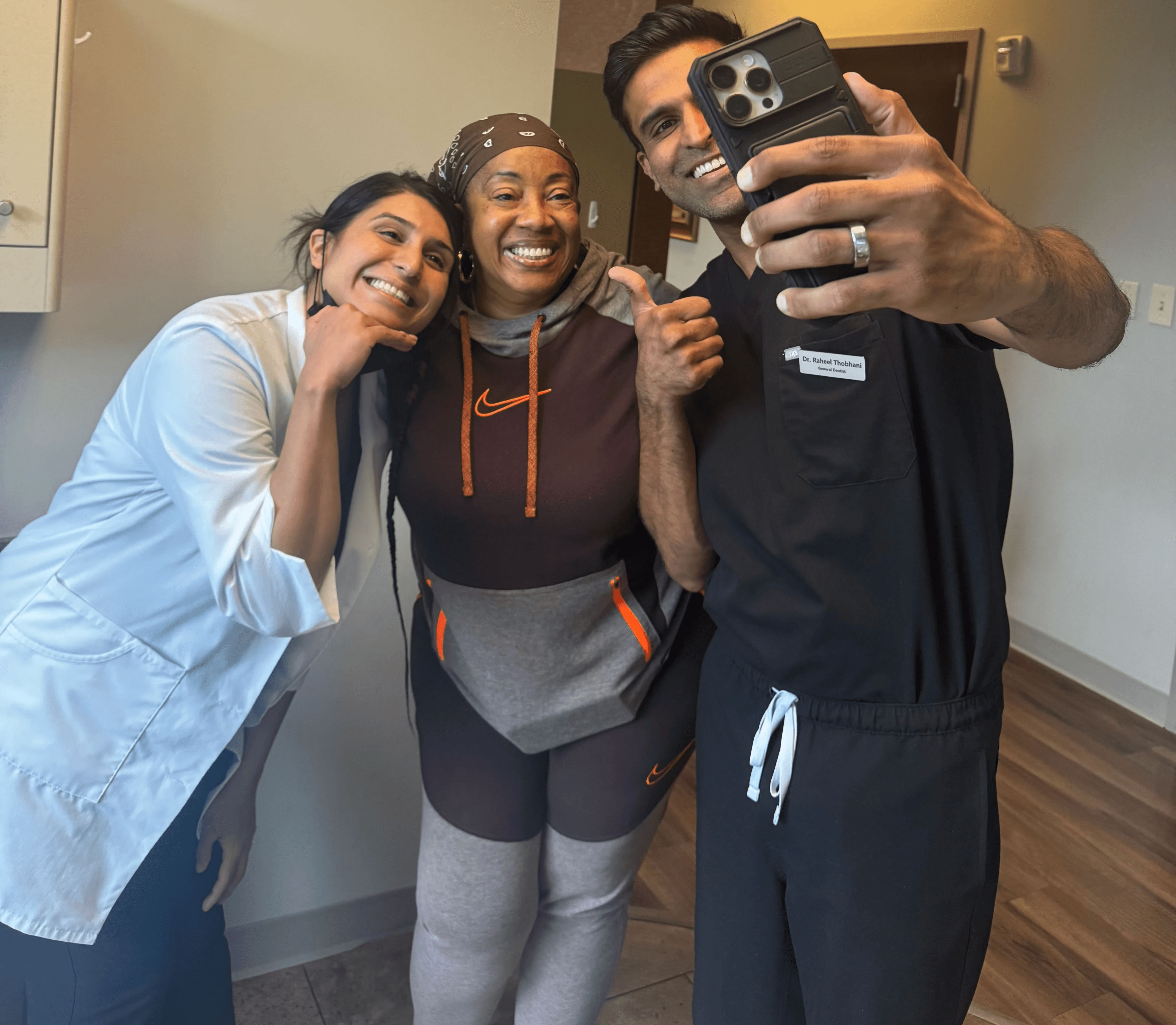
Even when your dental insurance does not cover the implant phase itself, certain components of the procedure are often eligible for partial reimbursement when documented as medically necessary. Tooth extractions, the diagnostic 3D CBCT scan that maps your jaw, and any bone grafting required to support the implants frequently qualify. Our implant and reconstruction lead, Dr. Raheel Thobhani, plans every All-on-4 case with a 3D CBCT scan and a written treatment breakdown, and our team verifies your insurance benefits in real time so we can submit each line item under the correct procedure code. We routinely see patients recover $1,500 to $3,500 from preliminaries that other practices would not have flagged for them.
Strategy 4: Phase the arches across two calendar years
If you need both upper and lower arches, the single biggest financial lever you have is timing. Doing the upper arch in December and the lower in January lets you deploy two years of FSA contributions, two years of insurance annual maximums, and two separate Cherry applications if needed. We see patients with both arches save $3,000 to $5,000 just by scheduling smart instead of doing both in one year. We sit down at the consultation, look at your benefits calendar, and map out the optimal timing before any treatment starts.
Strategy 5: Combine everything into a written, transparent plan
The single biggest mistake we see patients make is shopping All-on-4 quotes from different practices without comparing what each quote actually includes. One office's $19,900 quote may exclude bone grafting, sedation, and the final zirconia bridge, while another's $32,000 quote includes everything. We publish the All-on-4 cost transparency breakdown openly so there are no surprises later, and we hand every patient a written estimate at the consultation that shows exactly what insurance pays, what HSA/FSA covers, what Cherry finances, and what is genuinely out-of-pocket. Our implant team structures this conversation around your numbers, not theoretical averages.



Frequently Asked Questions
What is the cheapest way to pay for All-on-4?
There is no single cheapest path, but the lowest effective cost almost always comes from stacking 3 sources: max-funded HSA or FSA contributions for tax-free dollars (saves 22-37%), insurance applied to extractions and imaging, and Cherry financing for the balance. We see patients reduce their effective out-of-pocket by $4,000 to $7,000 just by using HSA dollars instead of post-tax cash. The patients we see paying the most are usually the ones who paid one practice with a credit card without knowing these options existed.
Will Cherry financing affect my credit score?
No. Cherry uses a soft credit pull at application, which does not affect your credit score. The application takes about two minutes and you get an instant decision during your consultation. We have patients across Smyrna, Marietta, and Sandy Springs use Cherry every week, and the most common feedback is surprise at how simple it is compared to traditional medical financing.
Can I use my HSA if my dental insurance does not cover implants?
Yes, and this is one of the most underused strategies. The IRS classifies dental implants as a qualified medical expense regardless of whether your dental insurance covers them. So even if your dental plan denies the implant claim entirely, your HSA dollars are still fully deployable on the same procedure with no penalty. The two systems are independent.
Can I combine CareCredit and Cherry?
Technically yes, though most patients we work with use one or the other, not both. Cherry tends to be the better fit for All-on-4 specifically because of the longer payment terms and the absence of the deferred-interest trap. CareCredit's 0% promotional periods can work if you are absolutely certain you will pay it off inside the window, but missing it triggers retroactive interest at 26.99% applied to the original loan. We help patients map out which works for their cash-flow reality at the consultation.
How do I know if I qualify for Cherry?
Most working adults with documentable income qualify, including patients with limited credit history or past credit issues. The minimum approval threshold is intentionally lower than traditional bank financing because Cherry was built specifically for healthcare and dental cases. The application happens during your consultation, takes about two minutes, and you get the approval amount before you sign anything.
What if I cannot afford All-on-4 even after using these strategies?
Then we have an honest conversation about alternatives. Implant-supported dentures (still anchored, just fewer implants), a phased single-arch approach (upper first, lower later when budget allows), or in some cases a high-quality removable denture as an interim solution. We never push patients into a procedure they cannot afford, and we would rather lose the case than have a patient regret it later. Smyrna Dental Studio refers out cases that aren't a fit and recommends honest alternatives when they make more sense.
The bottom line for Smyrna patients
All-on-4 is genuinely affordable for most working families, but only if you stack the strategies. The patients we see who walk in worried about cost and walk out with a confirmed treatment timeline all do the same thing: they let our team verify benefits, run the HSA/FSA math, apply Cherry, and schedule strategically. The patients who pay the most are the ones who never had this conversation in the first place. Smyrna Dental Studio is an ADA member practice with Spear Education trained doctors, and we maintain a 4.9-star rating across 200-plus verified patient reviews precisely because we run this transparency play with every single consultation.
Ready to map out your real number?
Stop guessing what All-on-4 actually costs you. Whether you are in Smyrna, Marietta, or Sandy Springs, the team at Smyrna Dental Studio verifies your insurance benefits in real time, runs the HSA/FSA tax math at the desk, and builds a written, itemized payment plan during your free consultation. Schedule your consultation today or call (470) 801-9986.
Written by Blake Hundley.